Showing posts with label Ramayana. Show all posts

Friday, February 24, 2012

The Ganges


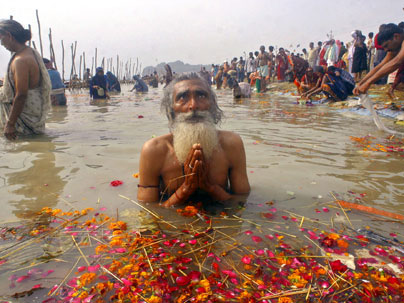
The Ganges river is in many way the heart of Indian civilization. For many, the Ganges is a source of daily life. Additionally it is the most sacred river to Hindus. For Hindus, the river personifies the goddess Ganga. The story of the Ganges' genesis is told in the Ramayana.  

Sakara, one of Rama's ancestors had many sons. His sons hastily tried to kill a saint they believed responsible for hiding the horse sacrifice in the depths of the Earth. The innocent saint, with only a glare burned them to ashes. Years later, Sakara's grandson, Bhagiratha wanted to bring their spirits to rest. He prayed and meditated for 30,000 years to gain the spirituality necessary to bring the Ganga down from high heaven. Her force hitting the Earth would tear it apart, so Shiva appeared and allowed the full force to come down his head, then hit the Earth. The clean waters flowed across the Earth, filling the pit that Sakara's sons dug while looking for the horse. This pit became the Earth's oceans. This water descended down to the ashes of Sakara's sons, releasing their spirits. The waters then nourished the people. Its waters can grant salvation. 

Thousands today rely on the Ganges and bathe in its waters to ensure their salvation. 

Here are some pretty pictures of the Ganges river.... 


Thursday, February 23, 2012

The Ramayana and Indian Values


I really delved into the Ramayana this week. I love how our class discussions on India have helped me understand the family structure and cultural values within the story. For example, Rama has an extended view of family. Although his father has three wives, he sees them all as his mother and makes no distinction. This is portrayed as honorable. The step wife, , at first is happy for Rama's coronation. It is only when her devious companion convinces her that her own son ought to be crowned. She dishonorably tricks her husband into banishing Rama before his coronation.

Rama is the perfect man. He is strong and handsome. He is the best hunter. He honors his wife. He is a loyal son to his father. He chose to honor his stepmother's decree that he be exiled for fourteen years though his brothers and the kingdom urged him to stay. His brothers are completely free of jealousy. They love him and are devastated when Rama is banished. They vow to follow him. Bharatha returns to be king only when the gods order him.

Friendship is valued as much as romantic love. When Jatayu, the Great Eagle discovers that Dasartha has died, he is so upset he plans to immolate himself. The friendship between the two was so strong, Dasartha described it as "You are the soul, I am the body. We are one." On the other hand, romantic love is all consuming and passionate. When Sita first laid eyes on Rama she went mad with love. She burned with fever, she "became uncontrollably agitated...withering of her whole being....prattling involuntarily... she felt all the elements were combining to aggravate her suffering." Of course Rama is a little more subdued and manly "Although he had exhibited no sign of it, deeply within he felt a disturbance. His innate sense of discipline and propriety had made him conceal his feelings before other people." He is certainly affected, but on a different level than Sita. While Sita lives for her husband, she completes him.

Understanding the Ramayana will help me gain an better understanding of Indian values.  If I can begin to understand the stories and gods that make up the rich Indian culture, I can begin to understand the people, their motivations, desires, and beliefs.